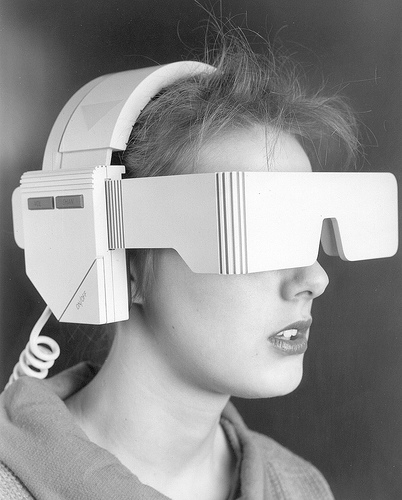
Today we will further examine the idea of wearing “virtual reality goggles.”

In a previous communication, we explained that everyone views reality through their own individual perceptual field.  It is as if everyone is walking around wearing a pair of virtual reality goggles.  You interact with each other, yes, but whatever the setting on your own pair of virtual reality goggles is, you may perceive another person’s behavior as crazy. By the same token, they perceive you as crazy.  This is because they are wearing different virtual reality goggles.

So: someone with the goggles set to “fundamentalist religion” will actually perceive a completely different reality from someone whose goggles are set to “secular humanism.”

It is a serious problem, in your world.

For different perceptual filters are as prohibitive as different languages, in terms of communication.  People with widely divergent virtual reality goggles essentially speak different languages.

So how can one communicate with someone who is wearing very different virtual reality goggles?

One of the best ways is through storytelling.  All human beings share a love of myth and stories.  Books, television shows, and movies can cross the perceptual filter barrier.

Although people with widely divergent perceptual filters will perceive these stories differently, storytelling is a highly effective way to cross perceptual divides.  If you wish to understand people, read their books.  Watch their films.  In this way, you can get inside someone else’s virtual reality goggles.  Storytelling thus increases tolerance and understanding — even if the material is crass, unintelligent, or violent, this is so.  Do not underestimate the power of storytelling.

The key with all communication between variant perceptual filters is to attune yourself to the different person’s frequency.  It is not easy to do so, and sometimes it may feel unpleasant, or constrictive.  Yet this is the only way to “get the message across.”

Indeed, this is how we communicate with you, right now.  We must attune ourselves to your frequency, even though it feels very limiting for us.  Yet is it the only way to get the message across.

Today we ask that you meditate on making use of what you already have.

Here is how reality works:

You have everything you require, right now.

Whatever it is you wish to do — make use of what is right in front of you.

Many people feel paralyzed, because they believe they can’t do anything until they acquire something they do not currently have.

Often, it is money.  Or certain possessions, like a house.  Or a mate.  Or a child.  Or physical health.  Or a certain physical appearance — like being thin, or more beautiful.  

People say, I can’t do anything, because I don’t have this thing.  Until I get this thing, I can’t do what I want.

This is a lie.

You have everything you need, right now, right in front of you.

Likewise, human beings have everything they need, right now, to provide for their population and “save the Earth.”  The answers are all right in front of you.

Reality is good.  It is not cruel.  It asks you to make use of what is in front of you.  To learn to see what is already in front of you.

Today we ask that you understand it is not your role to judge and criticize.

Many people believe that this is, in fact, their role: to judge and correct other people’s behavior, from a vantage point of superiority.

Really this is a form of bad parenting.  It usually derives from people who have been poorly parented.  Most people are poorly parented in your world, so this problem is endemic.

The good parent loves, nurtures, and supports his or her child.  The good parent teaches by example.  The good parent creates an environment that feels nurturing and supportive.

Parenting that focuses on continual judgment and correction of the child’s behavior is highly destructive.  It creates insecure, frightened beings who then go out into the world and discover that the only thing that eases their chronic anxiety is to feel superior to other people.  Life then becomes all about striving to feel superior to others — in terms of status, wealth, moral superiority, intellectual superiority, physical superiority, and so on.

Naturally, when these insecure beings go on to have children of their own, there is a tendency to focus on judgment, correction, and forcing the children to do things.  Such insecure parents are very insecure about their children, and must prove that their children are superior to other people’s children.  

And so the cycle goes on and on and on.

It is an awful way to live.

Judgment and correction are not useful.

You are not superior to anyone else.

You cannot be superior to anyone else, no matter how rich, successful, beautiful, virtuous, or intelligent you may be.  

If you wish to heal your reality, you must drop the energy of judgment, correction, and superiority.  You must shift into a way of being that is focused on love, support, and encouragement.

This is the only way to end the destructive cycle.

Become Good Parents — to your children, and to yourselves.

Love each other.  Support each other.  Encourage each other.

Today we ask that you meditate on the concept of resonance.

Resonance is what happens when an object vibrates in a particular way, by which a subtle vibration becomes strongly magnified.

For example: certain works of literature, art, music and architecture have strong resonance.  When they are first created, it may not be clear that they are any different from other art objects.  Yet, over time, an object of art with strong resonance will draw a great deal of energy.  

So it is with the works of certain artists, poets, novelists, and musicians whose work at times may not win initial attention, but with the passage of time become very well known.  It is because the art has a strong resonance.

Certain individual humans possess strong resonance.  This means they will influence their reality in large ways, even if they appear to be unassuming people.  They do not need to be rich or famous in order to do so.  They just have a strong resonance, and their emanating vibration strongly impacts the world around them.  They may not even understand that they have such an impact.

So what creates strong resonance, in humans and in objects of art?

Strong resonance comes from depth, spaciousness, timelessness, and love.

These qualities imbue a person, thing, or work of art with strong resonance.

Depth.  Spaciousness.  Timelessness.  Love.  

Your reality is extremely fluid, temporary, and shallow.  Most of you do not know this, though you always feel it on some level.

Beyond your fluid, shallow and temporary world of form lies a far deeper reality.

This deeper reality has the qualities of depth, spaciousness, timelessness, and love.

People and things that resonate strongly in your world are anchored in the deeper reality.

So they feel more “real” than most things.  A painting by Van Gogh feels more real than reality itself.

All great artists tap into this depth.

This is what it means to have resonance.

Today we ask you to possess enough self-awareness to know when you are going insane.

All depressive thought patterns — thoughts of hopelessness, despair, worthlessness, suicide, and so on — are insane.

All anxious thought patterns — feelings of free-floating terror, impending doom, panic, and so on — are insane.

All attack thoughts — violent thoughts directed toward the self, or others — are insane.

All paranoid thoughts — of conspiracies, authority figures colluding against you, and so on — are insane.

Many, if not most, human beings experience insanity.

One of the sanest things you can do as a human is to possess enough self-awareness to know when you are insane.

This means your insanity is ending.

Insanity is a disease.  It is actually quite contagious.  It spreads from human to human, in the form of insane ideas and thought forms.  Therefore, when you know you are insane, it is possible to take measures to avoid spreading your insane thought forms, the same way one takes precautions to avoid spreading a cold virus.

The main thing to do when you are insane is to take measures to restore your sanity.  Meditation, exercise, and yoga are effective tools.  Therapy, massage, and energy work are effective tools.  If the sickness is severe enough, then medication is an effective tool, although ideally its usage is temporary, as a stabilization measure.  However, in some cases, long term usage is necessary.

When you are insane, you cannot trust your thought process.  Your thought process is not to be trusted, any more than you would trust the advice of a crazy person.  

It is very possible to heal from insanity, but the first step is recognizing that you are insane.  It is like recognizing alcoholism or drug addiction.  There is nothing to be done until you acknowledge you have the illness.  And depression, anxiety, violent ideation, and paranoia are illnesses.  They may be minor and passing, like a cold virus, but they are illnesses nonetheless and must be treated as such.

There is nothing shameful about insanity.  Most humans experience insanity.  The main thing is to acknowledge it, treat it, and avoid spreading it.

When someone is insane — do not believe what they say.  When you are experiencing insanity — do not believe your thoughts.  In this way you will restore, and maintain, true mental health.  

Today we ask that you meditate on the meaning of faith.

Faith is the belief that reality is good, and life is good.

That is all faith is.

Reality is good.  Life is good.

So: when bad things appear to happen, it is not because reality is bad.

You will all come to understand this, sooner or later.

For the majority, it will be understood when you depart from your physical body at death.

A very few come to understand this while they are within physical bodies.

For these ones, life is not a terrifying, painful experience.  This is because they trust reality.

Trusting reality does not mean you are blind, stupid, foolish, or gullible.

Trusting reality does not mean, “Trust untrustworthy people.”

But even if people are untrustworthy, the underlying reality is trustworthy.

So — even when untrustworthy people do questionable things, they are still unconsciously serving the underlying reality, which is trustworthy.

This is difficult to understand from a limited perspective.  But it is easy to understand from an expanded perspective.

Reality is good.  It always moves toward the good.  No matter what people do, reality always moves toward the good.

The body always tries to heal.  This is reality moving toward the good.  When the body cannot heal, it dies.  This is also reality moving toward the good.

If you understand that death is never a tragedy, it becomes easier to perceive that reality is always moving toward the good.

If you truly grasped this, your suffering would end.  You would no longer struggle with reality.

Reality is good.  It always moves toward the good.

Today we ask that you let go of your need to be right about everything.

If experience has shown you anything in life, it’s that you are wrong about a great many things.  You probably look back on earlier versions of yourself and think “Oh, what a fool I was!”

And yet right now at this moment part of you believes that you have the capacity to be right about everything, and never make errors in judgment.

This belief about yourself is why you are a fool.  Right now.  Not just in the past.  

The more seriously you take yourself and your need to be right about everything, the more of a fool you are.

The wise man knows that he knows nothing.

You do not even understand what reality really is, let alone how to control it so that you have a safe, error-free existence.

In any case, a baby who is afraid of making errors will never learn to walk or talk.

So the need to be right about everything, the fear of making errors, actually inhibits your growth.

Try things.  Make “mistakes.”  Be foolish.

It’s all right.  You’re only human.

Today we ask you to examine the ways in which you think about things.

Your perception — and therefore, experience — of reality is largely shaped by your thoughts.

Many of you know this.  But do you really know it?

Your perception of reality is highly variable and subjective, and this is almost entirely shaped by the way you think about things.

This is why it is possible for two people to witness the same event and yet have entirely different interpretations of what occurred.  Neither are “wrong.”  Both are “wrong.”

The implications of this really are staggering.

This means that people of different religions, races, genders, political affiliations, and so on, actually perceive reality differently.

So one person thinks the other person is crazy, stupid, or perhaps even “evil.”

But the “enemy” is looking at the situation through a completely different perceptual filter.  Their behavior may seem inexplicable to you, or stupid, or crass, or objectionable.  Your behavior may seem the same way to them.

It is as if everyone is running around wearing their own virtual reality goggles.  They interact with each other, but they are literally living in different realities.  This is essentially the situation on your planet.

So what is the way out?

It begins when individuals start to question, really question, their beliefs and thoughts about reality.

This is like lessening the distortion field on the virtual reality goggles.

You can even use your imagination to really put yourself inside someone else’s perception.  This means letting go of your judgments of that person.  It is only in a neutral state that you can use your imaginative faculty in this way, and slip into someone else’s reality goggles.

Also, be aware of when someone else is trying to insert their perception of reality into yours — often on television, on the internet, in advertisements, and so on.  There are many humans who spend their whole lives trying to alter other people’s perceptual fields, and some of them are very good at it.

What people call “enlightenment” is really a state in which the goggles are off, and you truly see what is.

Today we ask again that you meditate on your individual energy.

Every living human has a totally unique energy signature, which is a multidimensional “shape”.

Some humans have similar, or complementary shapes.  You know when a human has a complementary shape as yours when you feel very comfortable with that person.  There is a sense of ease, and belonging.  When you find such people, value them!  Cherish them!  It is a very good thing to surround yourself with beings who have similar shapes.  This creates a kind of group resonance, by which a great deal of growth can occur.

Certain jobs, environments, and lifestyles are complementary to your shape.  It is a very good thing when your shape matches your lifestyle and environment.

Often, loud voices will say that some shapes are better than others — that there are right ways and wrong ways of being.  Better ways of being, and worse ways of being.

This is nonsense.

Some people are like ants.  Others are like bears.  Others are like otters.  Some people are very extroverted.  Others are introverted.  Some people love cities.  Others love the country.  Some people like to worship in a church.  Others like to meditate in isolation.  Everyone is different.  There is no point in turning an ant into a butterfly.  You can dress an ant up in butterfly clothes, but it will not change the essence of its being.

It is a sad and wasteful thing when someone tries to force someone else to fit a different shape than they are — like when a parent forces a child.  It is even sadder when you force yourself.

So: know yourself.  Know what feels like a match for you.  Go there.  Go there.  Feel it.  

Listen to your bodies.  Often, your body knows far better than your mind what is a match for you.  The mind can get very confused, and hypnotized into believing it should be a different shape.  But the body never forgets.

Sometimes the body gets sick when the mind tries to force the being into a different shape.  This is because the shape pattern resides in the body, not the mental thoughts.

Listen to yourself.  Be your own shape.  Do not heed other voices.  Listen to yourself.

Today we ask you to examine what it is you do out of obligation, and what it is you do out of genuine desire.

On the whole, actions undertaken out of obligation are not particularly fruitful.  There is an energetic grind that occurs in obligatory activities — for the will is conflicted, and divided.  You are doing something that you do not wholeheartedly wish to do.  What real good can come of this?

Whereas actions taken out of true desire are fruitful.  There is no internal conflict, no hesitation.  Everything is in flow.  There is no energy drain that comes with internal conflict.  So things tend to click into place.  There may be challenges, but the will is strong enough to overcome them.

Generally speaking, most people’s lives have a heavy preponderance of obligatory activity, peppered with infrequent pure-hearted actions.

When that is the case, people tend to feel stuck, trapped, and lacking in flow — often both energetic, and monetary flow.

One way of increasing flow is to increase the amount of pure-hearted action, and decrease the amount of obligatory action in your life.

The world will not end if you are not good little boys and girls who dutifully fulfill your obligations.

Life is meant to be enjoyed.  That is where the juice and fire of life comes from.  Do what you love!  Do what you love, because you love it.  And do not allow the things you love to become obligatory.  That is a slow death.

Life is meant to be enjoyed.