Today we ask that you recognize the value of destructive forces.

You live in a reality in which nothing is permanent.  Nothing lasts.  In time, even the pyramids of Egypt will be worn down to sand and dust.

Most people find this very threatening.  They desire permanence.  They want to make their mark on the world.  They want to build dynasties, so that even if they die, their children will succeed them.

But this is impossible.  Not even the most powerful of dynasties ever lasts.

All empires crumble.  People who were famous in your world fifty years ago — or less — are already forgotten.

But this does not mean that everything is hopeless, and that there is no point in doing anything.

It simply means that everything you do happens in this present moment.

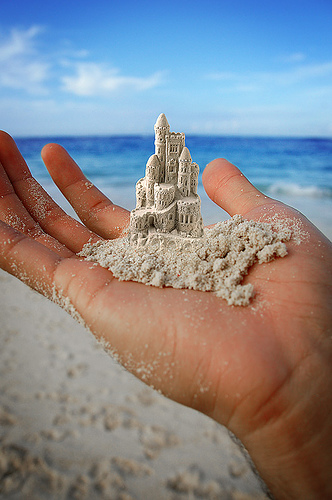
When children go to the beach, they build sand castles.  They do it with great joy.  They often take equally great joy in the destruction of the castle, as the waves roll in.

Children build great towers of blocks, then gleefully destroy them.

They understand that without destroying the sand castles and towers of blocks, there would be no room to build something new.

Think what this world would be like if no one ever died, and nothing decayed.

There would be no room!

No room for new things.

And that is why the destructive force is a part of life, and can be embraced.

Children are more present than adults.  They know that if a sand castle is destroyed, they can build another.  They enjoy the play, the process.

All things must pass.

That includes your trauma, and your pain.  All your suffering, all your grief.  Time is even now washing it away, just as it is washing away the pyramids.

In this way, even death can be a comfort — for it is true that sooner or later, all your trauma and pain will pass.

Despite the myths that certain religions promulgate, there is no such thing as everlasting torment.

You dwell in a good reality.  Destruction has its place, and is an essential part of creation.

If you can meet the dark face of reality with understanding and acceptance, then you will be liberated from fear.  
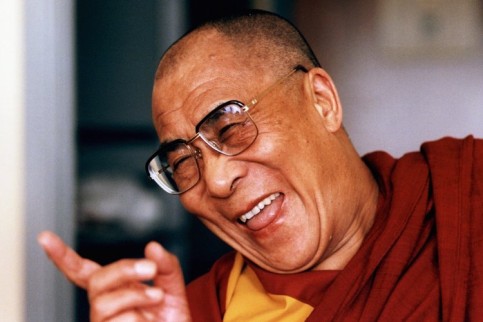
Today we ask that you not take everything so seriously.

Sometimes people are very humorless as they go through life.  They think life is a serious business.  The world is a terrible, difficult place, and only a fool would think there was anything to smile or laugh about.

Of course, it is known that the great sages of history usually seemed like fools to their fellow men.

Life is meant to be enjoyed.  Even animals play, and bask in the sunshine.

But sometimes humans think it is irresponsible to play, and bask in the sunshine.

Some well-meaning people are so troubled by all the injustices in the world that they believe it is wrong to smile, or laugh, or have a good time, when there is so much suffering.

These people are missing the point.

Being humorless and serious all the time doesn’t help anyone.  It just makes you an unpleasant person who causes as much misery as does good.

Anything worthwhile in this life can be done with a smile.

Comedies are worth just as much as tragedies — and often are much more effective at easing suffering.

If you persistently engage in activities that bring you no joy, perhaps you need to question why it is you do these things.

If you ever feel like you’ve lost your sense of humor or can’t smile and laugh, then it is time to take a step back and really look at the way you are living.  

Today we ask that you begin to question your beliefs about victims and oppressors.

Most people believe that the world is divided into two classes:

Victims, and oppressors.

Haves, and have-nots.

Victims are usually identified as anyone whose well-being is dependent upon a suppressive authority figure.  The suppressive authority figure is identified as the oppressor.

This plays out on both a small scale, and a large scale.

On a large scale, the poor people of the Earth are the victims of a small group of wealthy oppressors.

On a small scale, employees are the victims of their bosses.   Children are the victims of their parents, teachers, and other children. Women are victimized by men. 

The weak are victimized by the strong.

And so it goes.

What is generally not understood is that without exception, all oppressors feel like victims.

If you sat down with any individual you consider an “oppressor,” and got him to open up, you would invariably discover that the oppressor feels terribly victimized.

The cruel boss, for example, almost always feels victimized by his higher-ups.  He feels victimized by the pressures placed upon him.

The abusive parent always feels victimized — by bosses, by her spouse, and even by her children.

Do you think rich people don’t feel like victims?  Then you’ve never met a rich person.  If you sat down with any rich person, you would hear a long list of ways in which she feels victimized by life.

What does this mean?

It means that labeling individuals and groups as “victims” and “oppressors” is not useful.

This is no way to minimize anyone’s traumatic experience, or to condone abuse of any kind under any circumstance.

It just means to stop labeling people as “victims” and “oppressors,” because that is not useful.

Humans are humans.  People are people.  Everyone feels like a victim.  Everyone has, at one time or another, misused his authority — most often toward himself.

Who is the victim and who is the oppressor when you behave abusively toward yourself?  When you attack yourself with critical thoughts and judgments?

So you have all been victims and oppressors.  You have all been slaves and tyrants.

Defining yourself as a “victim” is a very destructive thing to do, for it tends to perpetuate itself in your life experience.

Furthermore, people who see themselves as slaves and victims inevitably behave abusively — either toward subordinates, or themselves.  That is why this belief system is so destructive.

Instead of labeling people as “victims” or “oppressors,” can you just see people as people, in all their vulnerability, mess, and complexity.

They are no different from you.  And if you were in their situation and had been raised and programmed by their parents and culture, you might behave in ways that you currently find odious.

If you truly wish to be free in this lifetime, the most useful thing you can do is to release the story that you are a victim.

If everyone is a victim, then no one is a victim.  You are all just human.


Today we ask that you appreciate the good that you have done this week.

This is a more difficult practice, for most, than simply appreciating the good things in your life.

Most of you may feel some resistance come up when you reflect on all the good things you have done this week.

Many of you will hear a voice say: “Not good enough!”  Or “You should have done more!”

Push past this resistance.

Reflect on all the good things you did this week.

Reflect even on things that you might be tempted to label as “insignificant.”

And if you cannot find a single thing you did this week that you can call good, keep digging until you do.

Maybe you loved an animal.

Maybe you made a healthy choice for yourself.

Maybe you had a interaction with another person, in which there was a smile, or laugh, or a sense of good feeling.

Maybe you challenged yourself.

Maybe you were kind to yourself.

Maybe you learned something.

It doesn’t have to be any kind of “accomplishment.”  No one else needs to be involved with this.

It can be as simple as brushing your teeth.  Brushing your teeth is a good thing.

So just start somewhere, and please sit in appreciation of all the good things you have done this week.

Notice resistance, if it arises.  Don’t get lost in those thoughts.  Just notice them.

Isn’t it interesting, how hard it is to appreciate yourself?

Today we ask that you let go of the desire to “save” people.

Many people, with good intentions, get it in their heads that they need to be White Knights, and go out and romantically “save” people.  

Generally, this happens when you judge that someone’s life is lacking in some particular way, and you think you know the perfect solution to their problems.

Usually this is a recipe for a mess.

It is one thing if someone comes to you, and asks for help.  If that happens, and you have the ability and desire to help this person, then by all means do so.

But deciding to intervene in someone’s life, when that person has not asked for help, is in almost all cases a bad idea.

The rare exception to this rule is if someone is in severe physical and/or mental distress, and is in a state where he cannot ask for help.

However, generally speaking, when the situation is not extremely severe, deciding to intervene in someone else’s life without their permission is a misuse of energy.  It almost always backfires, and makes things worse.

This includes time spent thinking about how you could “fix” someone else’s life, if you only had the chance.  If only they would listen to your wisdom.

You cannot really ever know another person.  You barely know yourself — so how can you know another person?  All you know of that person is a projection.  A fantasy version of the person, who exists nowhere outside your mind, like a character in a movie.

Maybe in your fantasies you could do wonderful things to help this other person, and “fix” his or her life. But in reality, if you were King of the Universe and could magically control this person and get them to do what you think would be best for them, it would be a disaster.

Of course, the worst misuse of this kind of energy happens in parenting, where well-meaning parents attempt to “fix” children who are not, in fact, broken.

Maybe no one needs to be “fixed,” or “saved.”

If you find yourself filled with the magnanimous desire to “fix” or “save” people with your wisdom, here is what you can do:

Go look in the mirror.

Put all that “fixing” and “saving” energy into yourself.

That other person you want to “fix”?  Really, it’s you.  When you are imagining all the ways you can save other people, really it is yourself that you unconsciously desire to save.

So why not take a shortcut, and put that energy where it belongs.

Help yourself.  Work on You.

Once you get stable within your own consciousness, you might find that you no longer have the desire to “fix” anyone.

You might just find that you love and accept them as they are.

Today we ask that you meditate on creating good space.

What does this mean?

Most of you are taught that to accomplish things in life, you must always be doing things.  You must be busy little workers, burning the candle at both ends.

Really, this is not so.

More than half of any creative process is not in the doing of things, but rather in creating a good space.

For example: if someone wishes to paint a picture, she must first create a good space, i.e. some sort of artist’s studio environment.  She needs a room with good light.  She needs her artist’s tools, her pencils and paints and brushes, her canvas.  That is the physical space.

But the physical space is not sufficient.  To create the painting, the artist must also create space in time.  She must set aside dedicated time to the effort.  Preferably quiet, meditative time in which she can focus on the task at hand.

Thirdly, she must create space within her own mind.  If her mind is racing with thoughts about doing laundry or paying bills or arguing with the landlord, then there will be no space in her mind for the act of creation.

If there is no space in the mind, then the artist may have a lovely studio and plenty of time — and still nothing will get done.

So, these are the three forms of space: physical space, time space, and mind space.

When space is created in all three at once, wonderful things can be done.

A good teacher knows how to create space for her students to learn.

A good healer knows how to create space for her patients/clients to heal.

In theater, a good director knows how to create space for the actors, the crew, the play, and the audience.

A good orchestra conductor knows how to create space for the musicians, and the music.

A good chef knows how to create space for the food.

A good gardener knows how to create space for the plants.

A good parent knows how to create space for the child.

Can you see the pattern?

So: next time you are fretting about getting things accomplished, reframe your thoughts.

Instead of thinking about all the things to do, reflect on creating a good space in which something can happen.

You will need physical space, time space, and mind space.

Focus on all three: physical space, time space, and mind space.

Then see what unfolds.


Today we ask that you have patience with people who are unconscious.

For those of you who are very sensitive and awake in this world, reality often feels like a deeply hostile, unwelcome, insane place.

In truth, there is nothing wrong with reality.  Reality itself is good.

It is just that most people in your world are unconscious.

Many of you have seen “zombie movies.”  Zombie movies speak to a deep awareness that the world is full of unconscious people.

Unconscious people, like zombies, have no idea what it is they are doing, or why.  They are totally controlled by programmed conditioning.  This is partially genetic — the great weight of all your ancestors, and their patterns.  The rest is cultural conditioning learned in childhood from parents and authority figures.

In conflict with this programmed conditioning is the “True Self.”  The True Self is the part of people that begins to wake up and resist the programmed conditioning.

For example: the daughter of a fundamentalist Muslim father who believes that violent terrorist acts are the work of holy martyrs might, after having a child of her own, repudiate her father’s beliefs, for she can perceive how her own child is no different from the children of the “enemy.”

That is how the True Self rises up against programmed conditioning.

Historically, most people do not do this.  They go with their genetic and cultural conditioning, and remain unconscious.

But there are always a few in every generation who wake up and move against the tide of unconsciousness, advancing and evolving humanity.

Such people often feel like they are surrounded by “zombies” — for their vibrance and consciousness is often met with indifference or hostility from the bulk of those they interact with.  And so we have great lights like Da Vinci or Van Gogh, who struggled terribly in their lifetimes.

It is often not easy to be awake in a sleeping world.

But it becomes easier when you learn to have patience and tolerance for the unconscious.

Unconscious people do not understand that there is another way to be.  They are usually very unhappy, but they do not really comprehend that states of well-being or joy are even possible in this world.

When you begin to have compassion for the unconscious ones, and have patience for them, your experience of life will improve.

Unconscious ones are very reactive.  If they sense any hostility or aggression toward them on your part, they will often react violently — just like zombies.

But if you can move among them in a state of patient compassion, they will not sense you in the same way.  You will not trigger them.

And that is when you can begin to help them.

But this can only happen when you are stable and awake in your own mind, and no longer part-zombie yourself.  This means unplugging from your own genetic and cultural conditioning, and following the voice of your True Self.

It is always a dance to be awake in a zombie world, without arousing aggression and hostility.  But the clearer you are in your own consciousness, the easier this dance becomes.

Eventually, you can be like “Neo” in “The Matrix,” and — with a compassionate heart — walk awake without fear in a sleeping world.

Today we ask that you consider the ways in which you think of yourself as a “slave.”

It is a very pervasive thought form in your world.

Many believe they are “slaves to their paycheck.”

Some feel enslaved by their responsibilities.

Some feel enslaved by their parents.

Some feel enslaved by their spouses.

Some feel enslaved by their children.

Some feel enslaved by their possessions.

Some feel enslaved by their debt.

Some feel enslaved by their poverty.

Some feel enslaved by society.

Some feel enslaved by religion.

Some feel enslaved by an angry God.

Some feel enslaved by illness.

Some feel enslaved by their bodies.

Some feel enslaved by their sexuality.

Some feel enslaved by their race or gender.

Some feel enslaved by their past.

Some feel enslaved by their future.

Some feel enslaved by their addictions.

With the feeling of enslavement comes a feeling of being trapped, imprisoned, and helpless.  There is no way out.

So: we ask you to look at the ways in which you feel enslaved.

And once you have it in mind, ask yourself: “Is it really true, that I am a slave to this thing?”

Is someone literally holding a gun to my head, forcing me to do this thing?

Is there truly no escape, no way out?

Even if you are dealing with physical illness, is there truly no other way to feel, other than that you are an oppressed, helpless victim?

Can you see that you actually do have power, and that you are nobody’s slave?

Even with addictions, there are ways in which you can reclaim your power.  There is help.  

No one is forcing you at gunpoint to remain in a job you despise.

Helplessness is a learned behavior.  It is usually learned in childhood.  Once learned, it tends to become a way of life, even after one has grown up, and is no longer at the mercy of parental authority figures.

Children often feel like slaves.  They have no say in what is happening to them.  While obviously a child cannot do whatever she wishes at all times, more aggressive forms of forcing a child’s obedience can have a debilitating effect on their consciousness.  It creates a slave.

When people feel like slaves, sometimes they act out with violence.  When you feel like a slave, you sometimes falsely believe that violence is your only recourse.

The violence is either turned inward against the self, or outward against other people.

Certain forms of religious worship promulgate slave consciousness.  In such religions, God is portrayed as an object of fear; a capricious, angry, wrathful God.  Such a God is the ultimate master of slaves, and all who worship such a deity assimilate slave consciousness.

No such God exists.  This reality is purely loving.  This universe is purely loving.  It asks nothing of you.  It just loves you, the way a healthy, loving parent loves the newborn child in her arms.

It is not easy to drop slave consciousness, if it has been programmed into you.  But it can be dropped.

It can be dropped when you recognize that you truly do have a conscious choice about the things you do.  In all likelihood, no one is holding a gun to your head.

You are not a slave.

You are free, in this life.  The more you believe this in your heart, the more you will experience it.  

Today we ask that you stay grounded.

There is a great tendency in the world right now for people to be very ungrounded in their lives.

One one level, they are completely disconnected from nature, and its rhythms.  People do not spend enough time outdoors, with their feet on the earth.  They do not watch the rising and setting of the sun and moon, or truly experience the seasons.  They do not work the earth, or grow food.  All these activities are deeply grounding.

Instead, people spend their days indoors, under artificial lights, looking at computer and TV screens all day.  Their minds are continuously in a kind of daydream or fantasy mode — thinking thinking thinking. Thinking about the people and the stories on the internet and the TV.  Thinking about the future and the past.  Getting lost in the fantasies of movies, and TV shows, and video games.

There is nothing wrong with any of this.  But for most people, life has become deeply out of balance.  Too much time is spent in the mind, not enough in the body.

A whole host of illnesses arise out of this imbalance — insomnia, anxiety, depression, fatigue, and all the many stress-related illnesses.

The world as a whole also expresses this deep imbalance.  Humans cannot remain so out of touch with the natural world, without the natural world drawing attention to itself — just as individual human bodies draw attention to themselves by getting sick.  It might be said that your planet is currently running a fever.

As above, so below.  Most individual humans run in a state of nervous system overheating.  Many are “burnt out.”  Everyone is a little feverish and overactive in their minds.  With fever comes delirium.  When you are sick with a fever, you often experience terrible anxiety and fear, as the illness works itself through.

When you are sick with a fever, what do you do?

You ground yourself.

You drink hot tea and soup.  You allow yourself to rest, and sleep.

The more thoroughly you do this, the faster the illness passes.

Most people exist in a mentally feverish state, overstimulated by all the information they continually take in on the internet and TV.  Unable to cool off, and rest, and ground themselves.

Ground yourself.  Please, ground yourself.

Put down the phone, step away from the computer.  Turn off the TV.

Go outside.  Look at the sun and moon.  Feel the earth beneath your feet.

Go to a yoga class, and get back into your body.  Dance.  

Play with an animal.  Play with a small child.

Work in a garden.

Turn off the electronic stimuli, and just get back into your body.  Remember this planet you live on.  Listen to the birds.  Watch the clouds.

Slow down.  Cool down.  Rest.

Do you want to know how to save the world?  By doing this.